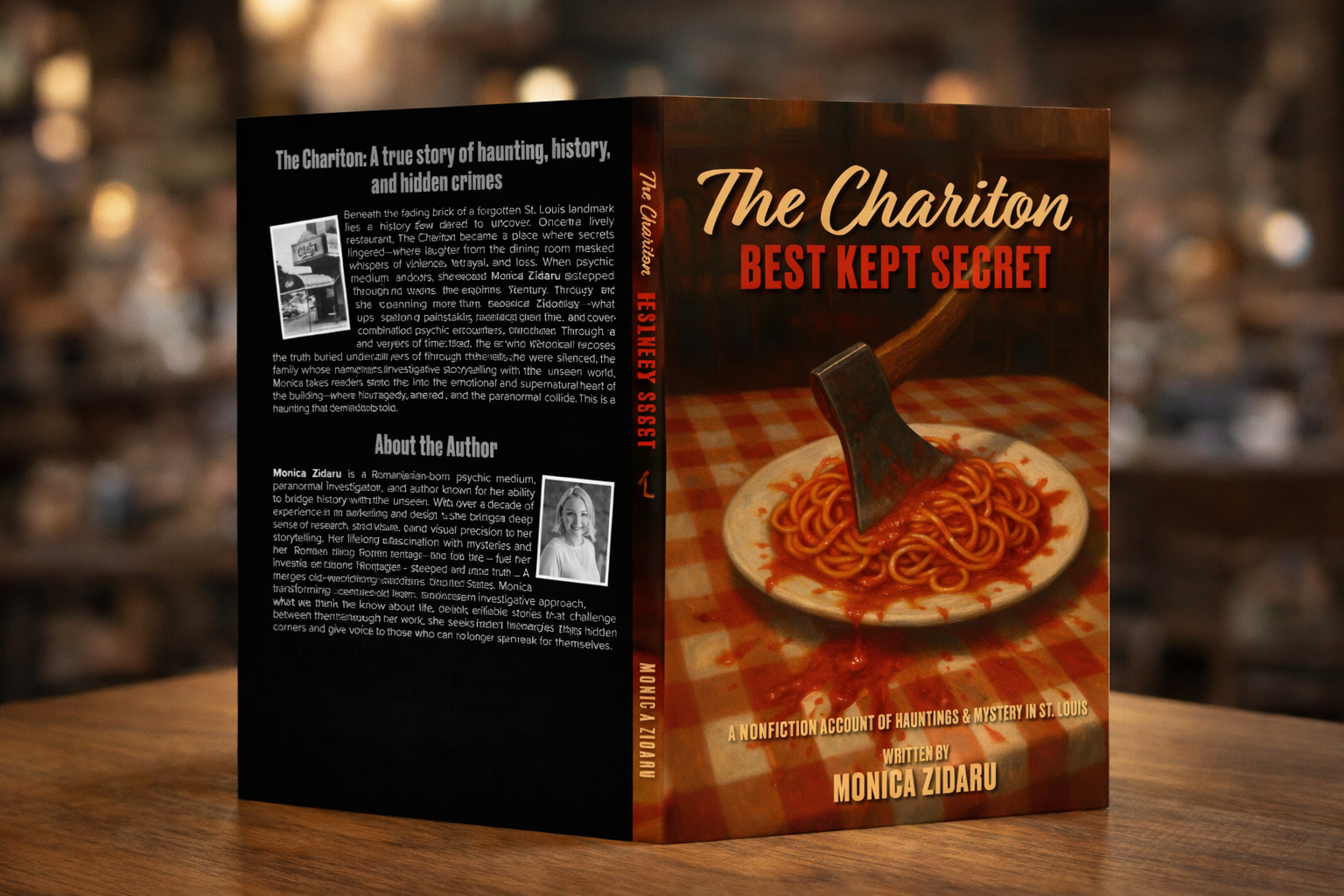
Get your copy of the e-book on Amazon here!
The Chariton: Best Kept Secret is a nonfiction account of hauntings, hidden history, and unresolved trauma tied to a long-forgotten St. Louis landmark.
Beneath the fading brick of a once-popular neighborhood restaurant lay a history few dared to confront. Known publicly as a place of dining and celebration, The Chariton quietly carried a second life—one shaped by violence, secrecy, and exploitation. For decades, fragments of its past surfaced only as rumors: whispers of organized crime connections, unexplained deaths, and paranormal disturbances dismissed as folklore.
When psychic medium and investigator Monica Zidaru began investigating the site, the intention was not to sensationalize its reputation, but to document it. What emerged was not a single haunting, but a layered narrative spanning generations—one that revealed patterns of silenced women, buried crimes, and a family legacy intertwined with fear and control.
The investigation combined traditional historical research with first-hand site work. Archival documents, city records, newspaper accounts, and eyewitness testimony were examined alongside verified psychic encounters experienced on location. Rather than standing apart, these two approaches—historical documentation and intuitive investigation—began to intersect in unsettling ways, reinforcing timelines, names, and unresolved events tied to the building.
At the center of the story are the women connected to The Chariton—many of whom were never given a voice in life, and whose experiences were deliberately obscured by power, money, and social silence. Their presence, along with that of other entities bound to the site, pointed to a broader truth: the building did not simply hold memories; it retained trauma.
As the investigation deepened, it became clear that this was not a story that could remain fragmented across notes, recordings, and research logs. The Chariton: Best Kept Secret was written to preserve that history in full—to document what was found, how it was found, and why it matters.
Blending investigative storytelling with the unseen realities encountered during the research process, the book brings readers into the emotional and historical core of the site. It does not ask readers to suspend disbelief, but to consider what happens when neglected history is finally examined—when patterns of harm are named, and when places are no longer allowed to forget what they witnessed.
Some stories demand to be told not because they are sensational, but because they were deliberately buried.
This was one of them.
No responses yet